Cooking peppers doesn’t create more heat, but it absolutely can make your food taste hotter, and in one case it makes the pepper itself measurably hotter too. Which way it goes depends almost entirely on whether you’re cooking with water or without it. Here’s what actually happens in the pan.

First, where the heat actually lives
The heat in a chili comes from capsaicin, and it isn’t spread evenly through the fruit. Most of it sits in the the pepper’s placenta, the white pith that anchors the seeds to the walls.
Here’s the part that surprises people. One study measuring the three parts separately in a habanero-type chili found the placenta at around 2,600 mg per 100g, the flesh at 1,738, and the seeds at 748. The flesh carries more than twice what the seeds do. So if you’re scraping out the seeds and leaving the pith behind, you’re doing close to the least effective thing you could do. The pith is the part that matters.
So does cooking make peppers hotter?
Two different questions live inside that one, and they’ve got different answers.
Does the dish taste hotter? Usually yes. Capsaicin barely dissolves in water at all, roughly 10 mg per liter, but it dissolves happily in fat. Put a chili in a hot pan with oil and the capsaicin comes out of the pepper and goes into the oil, and from there into everything else. Every bite you take gets some of it. That’s not more heat, it’s the same heat spread across the whole plate, and it tastes spicier because there’s no longer a bit you can push to the side of the plate.
Does the pepper itself get hotter? Only if you keep it dry. Boil it and it’ll lose capsaicin. Grill it and it’ll gain, at least by the gram. That difference is the whole answer, and it’s worth taking the two separately.
Boiling and simmering: the pepper loses
Researchers boiled eight Mexican pepper varieties at 205F, just under boiling, and measured what was left. What they found was capsaicinoid losses running from 1.1% to 28.1% across most of the eight, and jalapeños fared worst of all at anywhere from 10.6% to 52.2%.
The capsaicin didn’t burn off. It moved. Once the pepper’s cell walls break down, the capsaicin leaches into the surrounding liquid, and whether that counts as a loss depends entirely on what you do with the liquid. In a soup, a curry or a braise, that pot is the dish, so the heat’s still yours. Blanch a chili and pour the water down the sink and you’ve just poured a chunk of the heat away with it.
Roasting and grilling: the pepper gains
This is where the received wisdom’s got it backwards, and where the numbers are hard to argue with. The same study grilled those peppers at 410F and found capsaicinoid content had gone up, by anywhere from 2.6% to 924.9% depending on the variety.
No chili’s making fresh capsaicin over a flame. What a pepper does over high dry heat is lose water, and a lot of it, so everything that stays behind is packed into less material. Measure per gram and you’ve got a bigger number, and you’ll taste it too. If you want a roasted chili to hit harder, char it hot and fast and let it dry out. For a gentler result, roast it covered and let it steam. A hot, fast char is also where you get that lovely blistered sweetness, so this one’s no hardship.
The steam myth, and why it’s wrong
You’ll read in plenty of places that capsaicin is carried off in the steam, and that a long simmer lets it float away. It’s a tidy story and it doesn’t hold up.
Capsaicin’s vapor pressure is very low, and the standard toxicology reference on it says volatilization simply isn’t expected. It doesn’t ride out on steam. It’s also more heat-stable than it gets credit for: held at 212F for a full 90 minutes, a capsaicin solution kept over 95% of its content. So when a long-cooked pot tastes milder than you expected, the capsaicin hasn’t left the building. It’s spread thinner through more liquid, bound up in the fat, and buffered by everything else in the pot.
How to get more heat out of your peppers
- Leave the pith in: Not the seeds, the white membrane they’re attached to. The capsaicin’s concentrated in there, and leaving it in is the single biggest lever you’ve got before the stove even comes on.
- Cut them, don’t drop them in whole: A whole chili keeps most of its capsaicin inside itself. Slice or crush it and you open the pith up to the pan, which is how the heat gets out into the dish.
- Cook them in fat, early: Capsaicin goes into oil far more readily than into water, which is a great thing to know. Give the chilies five to ten minutes in the oil with your onions and garlic and the heat’ll be all through the finished dish rather than sitting in one corner of it.
- Char them dry: High heat, no lid, no liquid. The water leaves, the capsaicin stays, and what you’re left with is more concentrated than what you started with.
- Keep the cooking liquid: If you’ve simmered chilies in stock or sauce, a good share of the heat is now in that liquid. Reduce it and you concentrate it further.
How to take the heat back down
- Take the pith out, seeds and all: Worth doing properly with a teaspoon rather than a quick shake. You’ll lose a fair bit of the heat and keep nearly all of the pepper’s flavor, which is the trade you want.
- Boil rather than fry: Simmering in water pulls capsaicinoids out of the pepper, and jalapeños in particular gave up as much as half of theirs. If you then discard that water, it’s gone for good.
- Add the chilies late: Drop them in near the end and they haven’t got time to give much up to the fat, so the heat stays local to the pepper instead of spreading through every mouthful.
- Leave them whole and fish them out: A whole chili simmered in a sauce and lifted out before serving’ll lend you its flavor and only a fraction of its heat.
- Serve fat and acid alongside: Dairy and a squeeze of lime are the classic partners here, and they’re classic because they work, and How To Tone Down Spicy Food covers the full set of options.
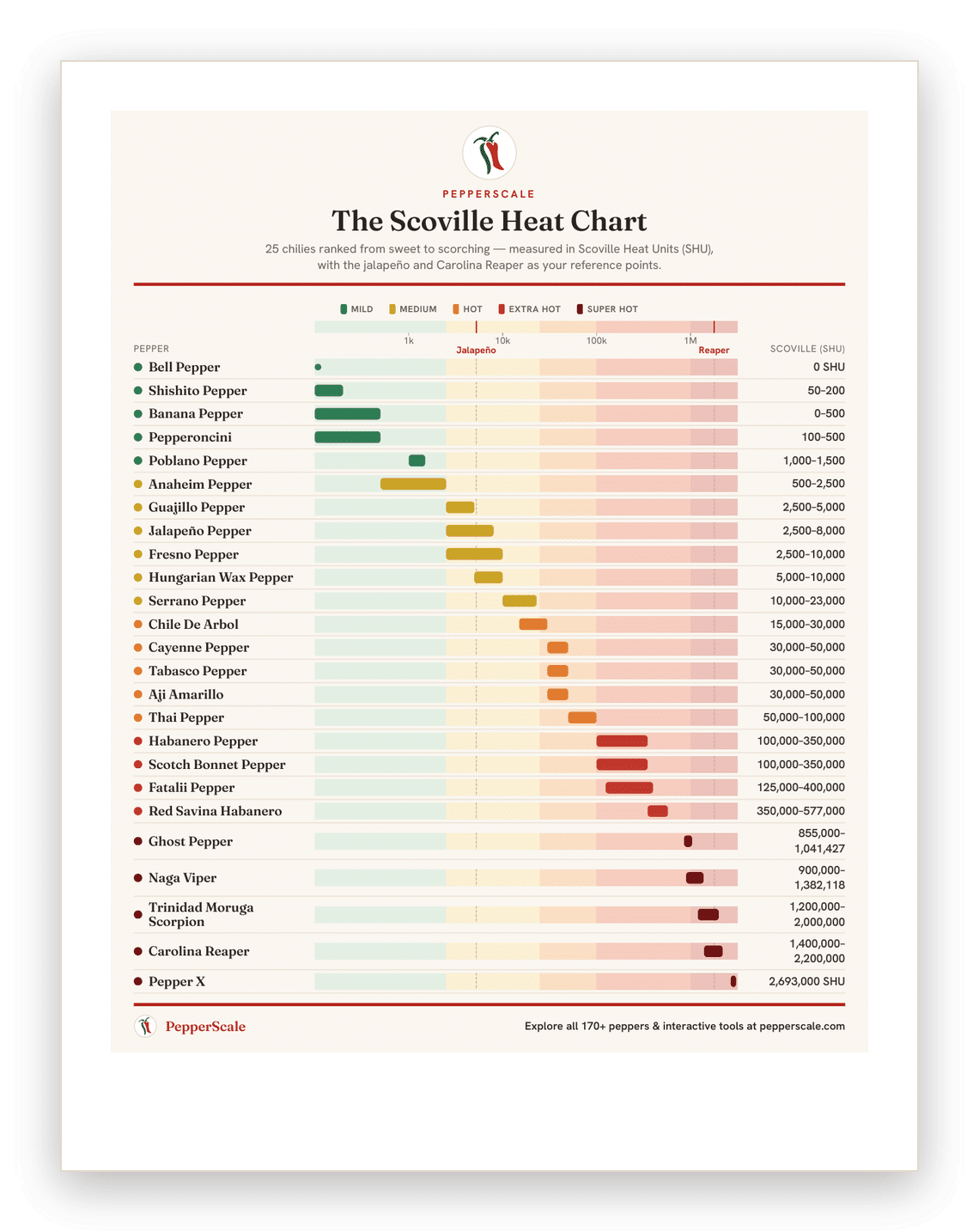
Get the free PepperScale Scoville Heat Chart
A printable, at-a-glance ranking of 25 chilies from sweet to scorching — with the jalapeño and Carolina Reaper as your reference points. Join the newsletter and we’ll send it straight to your inbox.
No spam — just Wicked Wednesday recipes and occasional extra dashes of chili pepper inspiration. Unsubscribe anytime.
Related reading
- Our Hot Pepper List: Discover over 150+ chilies, from serranos and habaneros to superhots like ghost peppers and Carolina Reapers. Search our list by name, heat level, flavor, and more.
- Male and Female Peppers: Is that for real? Or is it an urban legend that peppers have genders?
- What Are Scoville heat units? They are the unit through which the Scoville scale is measured, but what exactly are Scoville units measuring?