Capsicum annuum is the pepper species that covers bell peppers, jalapeños, cayenne, poblanos and serranos, along with most of what you’ll find in a supermarket produce aisle. It’s one of five domesticated species in the genus Capsicum, and it’s by far the largest. Our own pepper catalog lists 109 annuum varieties against 49 for the next biggest species, and it’s the only one of the five with peppers that carry no heat at all.

What is Capsicum annuum?
Capsicum is the genus that holds every chili pepper. Inside it, five species were domesticated separately, by different people in different places, and annuum is one of them. The other four are Capsicum chinense, Capsicum baccatum, Capsicum frutescens and Capsicum pubescens. If the genus and species business is new to you, we have a longer explanation of how the naming works.
Every pepper inside annuum belongs to the same species, however little they look alike. A blocky red bell and a thin dried cayenne are one species the same way a chihuahua and a great dane are one species, and centuries of selection account for the rest.
So the species label tells you less than you might expect. It describes the plant, and it says very little about the pod.
How do you tell Capsicum annuum from the other species?
Pod shape won’t help you. Annuum fruit runs from a sweet bell the size of your fist to a chiltepin the size of a pea, so size and silhouette will mislead you every time.
The flowers are where the answer is. Botanists separate the five domesticated species mainly on flower structure, seed color, and how many flowers appear at each node.
| Species | Flowers per node | Corolla | Calyx constriction | Seeds |
|---|---|---|---|---|
| annuum | Usually one | Creamy white, unspotted | Absent | Straw |
| chinense | Two or more | Greenish-white, unspotted | Present | Straw |
| frutescens | Two or more | Greenish-white, unspotted | Absent | Straw |
| baccatum | Usually one | White or greenish-white, with yellow, tan or green spots at the base of each petal | Absent | Straw |
| pubescens | One or two | Purple | Absent | Black |
Two of them you can call in seconds. Black seeds mean pubescens, and it’s the only one of the five that has them, usually with purple flowers to match. Spots at the base of the petals mean baccatum.
The other three are the hard ones, because annuum, chinense and frutescens are close relatives that shade into each other. When the flowers come one to a node and the petals are plain white, annuum is the safe call. Chinense and frutescens both tend to cluster two or more to a node, so the tiebreaker sits lower down: chinense has a small ring-shaped constriction where the fruit joins the stem, and it’s the only one of the five with it.
Anther color gets quoted a lot as a field mark, and it helps less than you would hope. Published descriptions put annuum anywhere from pale blue to blue-purple, and chinense from blue to purple, so the shades overlap and the sources disagree with each other.
Which peppers are Capsicum annuum?
Most of the ones you cook with. Of the 176 peppers in our pepper list, 109 belong to this species. Here is the ladder, with the Scoville range we have on file for each:
- Bell pepper — 0 SHU
- Shishito — 50 to 200 SHU
- Poblano — 1,000 to 1,500 SHU
- Anaheim — 500 to 2,500 SHU
- Jalapeño — 2,500 to 8,000 SHU
- Hungarian wax — 5,000 to 10,000 SHU
- Serrano — 10,000 to 23,000 SHU
- Chile de árbol — 15,000 to 30,000 SHU
- Cayenne — 30,000 to 50,000 SHU
- Pequín — 40,000 to 60,000 SHU
- Chiltepin — 50,000 to 100,000 SHU
That’s one species, top to bottom, which is why asking what species a pepper belongs to tells you so little about the pepper in your hand.
How hot does Capsicum annuum get?
From zero to around 100,000 Scoville heat units. Ten peppers in our catalog register no heat whatsoever, and all ten are annuum, with the bell pepper among them. That zero is a true zero: bell peppers carry a broken copy of a gene called Pun1 that the plant needs in order to make capsaicin, so it makes none.
At the far end, Thai peppers, chiltepins, Charleston Hot and Apache all reach roughly 100,000 SHU. That’s hot by any normal measure, and it’s still a long way short of what Capsicum chinense manages. A habanero starts at about 100,000, right where annuum stops. A Carolina Reaper runs from 1.4 to 2.2 million, fourteen to twenty-two times higher again.
So the ceiling here is lower than the reputation of chili peppers suggests, and almost everything below that ceiling is annuum.
What does Capsicum annuum taste like?
A single answer doesn’t exist here, and that’s the point of the species. Sweetness is the most common note by a distance: 66 of the 109 annuum peppers in our catalog carry a sweet tag, ahead of fruity, smoky and earthy.
Put it beside the other species and one difference stands out. Fruitiness is the rule elsewhere and the exception here. Our tags run fruity on 88 percent of chinense peppers and 83 percent of baccatum, against 22 percent of annuum. The apricot note people describe in a habanero is a chinense signature, and you will meet it only occasionally in this species.
Annuum lacks that kind of family resemblance. What it has instead is range, so when you want a particular flavor you’re choosing a variety and the species barely enters into it.
Where does Capsicum annuum come from?
Mexico. The wild plant it was bred from is the chiltepin, Capsicum annuum var. glabriusculum, a pea-sized pepper that still grows wild from the southern United States down through Mexico.
But where in Mexico is genuinely unsettled. A 2014 study in PNAS combined genetics, archaeology, linguistics and ecological modeling, and placed the origin in central-east Mexico, an area running from southern Puebla and northern Oaxaca into southeastern Veracruz, more than 6,500 years ago. A 2024 paper in the same journal argued for something messier: domestication in the lowlands instead, around the Yucatán Peninsula and coastal Guerrero, in at least two separate events at different times. Both agree on Mexico. Both stop short of naming a valley.
One thing worth clearing up, since it gets repeated a lot. You’ll see the origin of annuum given as southern Brazil and Bolivia, but that claim describes the genus as a whole, and even there the reading has moved on: a 2016 phylogenetic study places the birthplace of Capsicum along the Andes of western and north-western South America. Annuum is the Mexican branch of the family.
Is Capsicum annuum really an annual?
It isn’t. Linnaeus gave it the name in 1753, and it has been wrong ever since. Botanically these are frost-tender perennials, and cold finishes them long before age does.
Grow one where winters are hard and it behaves like an annual, because the first freeze ends it. Bring the same plant indoors beforehand, keep it above freezing with decent light, and it’ll fruit again the next year.
Are ornamental peppers Capsicum annuum?
Almost always. Of the 31 ornamental varieties in our catalog, 29 are Capsicum annuum, bred for black foliage, purple fruit, or pods that stand upright in clusters above the leaves.
And they’re all edible. They just aren’t mild. Black Pearl runs 10,000 to 30,000 SHU, level with a serrano, and Prairie Fire reaches 70,000 to 80,000. Decorative describes the plant alone, so we went through what to expect from them at the table in can you eat ornamental peppers.
One caveat if someone else grew it: a pepper sold as a houseplant may have been treated with something meant for houseplants instead of food crops, so it’s worth asking before you start picking.
How do you grow Capsicum annuum?
Peppers are slow to start and unforgiving about cold, and most of what goes wrong happens in the first six weeks.
- Start seed indoors six to eight weeks before your last frost date.
- Germinate warm. Seeds want soil around 80°F, and a heat mat is the simplest way to hold it there. Cold soil doesn’t kill them, it stalls them, sometimes for weeks.
- Hold off on transplanting until night temperatures stay above 50°F. Plants set out into cold ground sulk, and they’re slow to come back from it.
- Water about an inch a week, and soak the soil properly instead of sprinkling it daily.
- Expect fruit 70 to 85 days after transplanting, or 100 to 120 days from seed. Check the variety, because that spread is wide.
- Full sun, and somewhere sheltered if you can manage it. Tall varieties go over in wind once they’re carrying a crop.
Fresh peppers keep a week or two in the crisper drawer and freeze well whole or sliced. Any thin-walled annuum dries easily too, which is how cayenne, guajillo and árbol usually reach you in the first place.
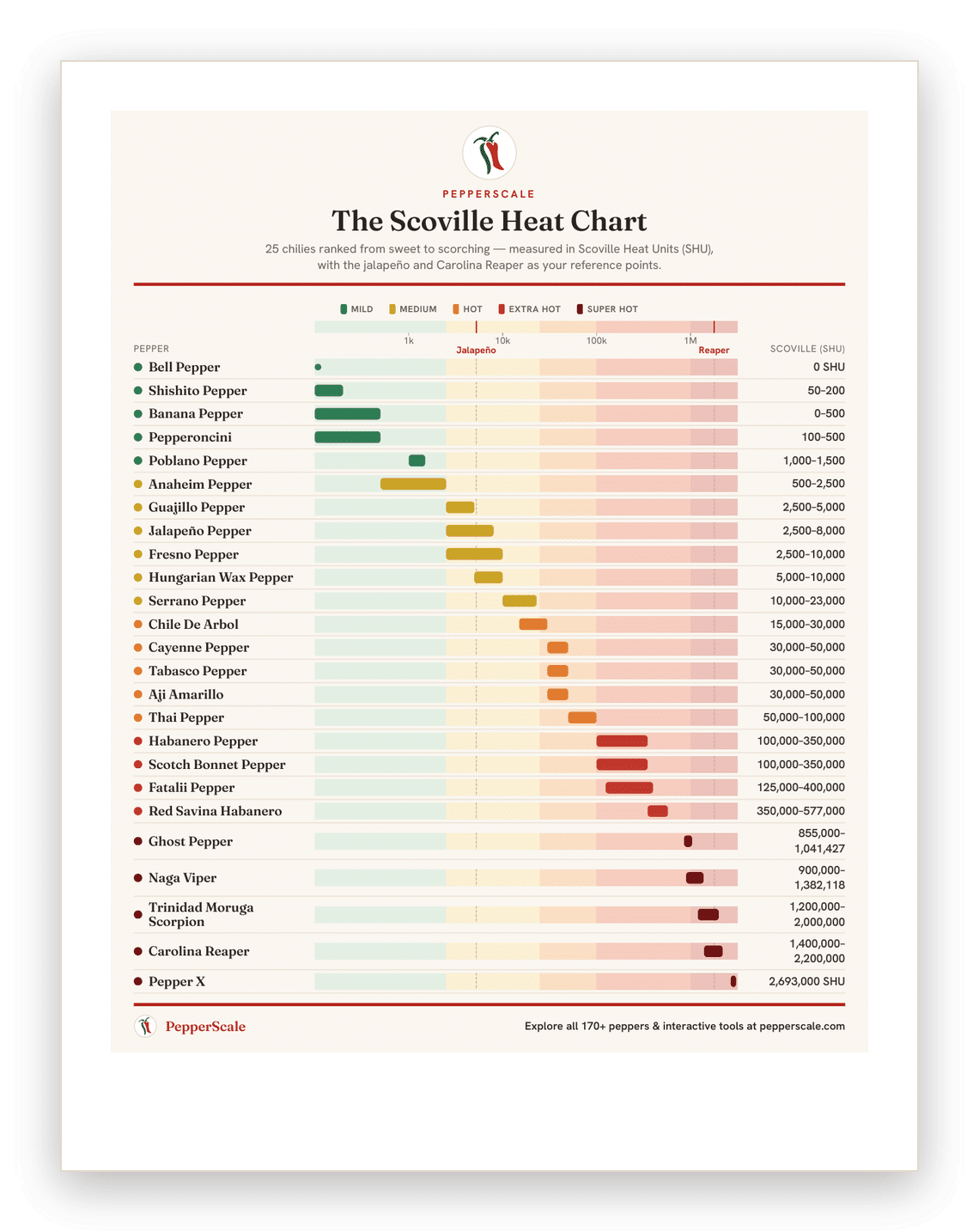
Get the free PepperScale Scoville Heat Chart
A printable, at-a-glance ranking of 25 chilies from sweet to scorching — with the jalapeño and Carolina Reaper as your reference points. Join the newsletter and we’ll send it straight to your inbox.
No spam — just Wicked Wednesday recipes and occasional extra dashes of chili pepper inspiration. Unsubscribe anytime.
Related reading
- Capsicum chinense: the species behind the habanero and every superhot that followed it.
- Capsicum baccatum: South America’s ajís, and the spotted flowers that give them away.
- Capsicum frutescens: small, clustered pods, and the source of the tabasco pepper.
- Capsicum pubescens: purple flowers, black seeds, and a pepper you eat like fruit.
- Genus vs. species: what the two halves of a pepper’s Latin name are telling you.
Photo by: Eric Hunt (Own work) , via Wikimedia Commons
