Wondering where that chili pepper heat comes from? Look no further: capsaicin. It’s the little compound that could when it comes to heat. It’s the active force behind the pungency of chili peppers, the driver behind the Scoville scale’s heat units, and that’s not all. It’s in pain-relief creams, a prescription nerve-pain patch and pepper spray, and it even had a hand in a Nobel Prize.
What is capsaicin?
Capsaicin is the natural compound that makes chili peppers hot. It’s one of a small family of related compounds called capsaicinoids, and it’s the biggest by far. In a typical chili, capsaicin makes up about 69% of the capsaicinoids, and its near-twin, dihydrocapsaicin, adds another 22%.
Only chili peppers make it. Every hot pepper you’ve heard of, from the jalapeño to the Carolina Reaper, gets its heat from capsaicinoids. Sweet bell peppers don’t make any, so they rate a zero on the Scoville scale.
The other hot things in your kitchen don’t get their bite from capsaicin. Black pepper has piperine, ginger has gingerol, and mustard, horseradish and wasabi have allyl isothiocyanate. They’re different compounds, even when the burn feels familiar.
For the curious, its chemical formula is C18H27NO3. Pure capsaicin is a white crystalline powder, and it barely dissolves in water, but it’ll dissolve easily in fat and alcohol. That last detail matters more than any other when your mouth’s on fire.
For chemical breakdowns of the compound, check out Wikipedia. It does an excellent job with explaining the advanced science in relatively basic language.
Where is the capsaicin in a chili pepper?
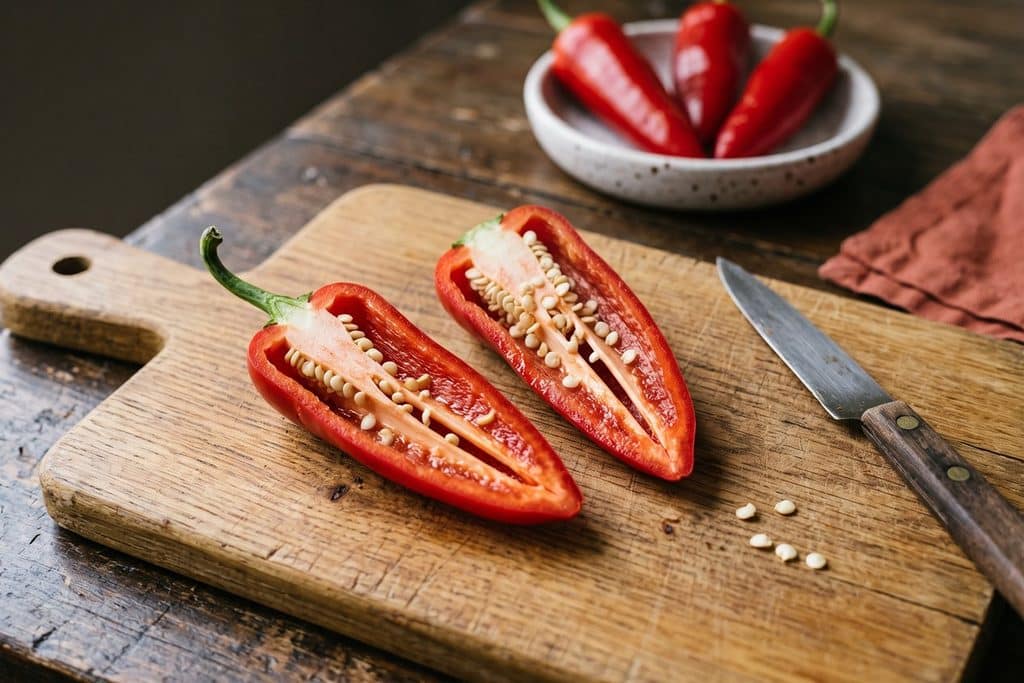
Most of it’s in the pale, spongy pith inside the pepper, called the placenta, which is where the seeds grow. The seeds don’t make any capsaicin themselves. They’re attached to the pith, though, so they pick some up, and that’s how they got their reputation as the hot part. Our guide to eating pepper seeds has the full story.
So when you’d like a milder dish, cut away the pith along with the seeds. That’s where most of the heat is.
Why do chili peppers make capsaicin?
It’s theorized that the peppers evolved capsaicin as a protective measure against being eaten by mammals or attacked by various fungi in the wild.
The research has filled that theory in since. Birds don’t feel capsaicin at all. Their version of the heat receptor still responds to real heat, but capsaicin doesn’t switch it on. That’s good news for the plant, since birds are the ones that spread chili seeds. A 2001 study in Nature found capsaicin puts off seed-destroying animals without putting off the birds that spread the seeds more effectively.
The fungus part holds up, too. A 2008 study of wild chilies found that a fungus called Fusarium kills more chili seeds before they’re spread than anything else, and that capsaicinoids protect the seeds from it.
But for us chiliheads, that capsaicin has the exact opposite effect. The heat adds something amazing.
The easy history
Capsaicin was discovered and extracted by Christian Friedrich Bucholz in 1816, just two short years before his death. What he had extracted was rather impure, so further work by John Clough Thresh and finally Karl Micko led to isolating and extracting the compound in pure form. It received its current name in 1876, though Bucholz originally called it capsicin. The name itself comes from the genus of nightshade flowering plants from which it was originally extracted (Capsicum).
Pinning down what it is took another century. E. K. Nelson worked out its chemical formula in 1919, and Ernst Späth and Stephen F. Darling first made it in a lab in 1930, according to a 2016 review in Molecules.
Its biggest moment came much later. In 1997, David Julius’s lab at the University of California, San Francisco, used capsaicin to find the sensor in our nerves that responds to painful heat, now called TRPV1. That’s the work that earned Julius a share of the 2021 Nobel Prize in Physiology or Medicine.
How it works: You’re eating an irritant
At the center of how it works is simply that it’s an irritant to all mammals. Yes, when you are eating a hot pepper, you are actually ingesting an irritant into your system. This is an irritant that causes a burning sensation really anywhere where there is direct contact with tissue. That can be your mouth, your hands, and even your eyes. If you’ve rubbed your eyes after touching something as mild as a jalapeño, you know what I mean. It’s not pleasant.
The nerve endings in your mouth, skin and eyes carry that TRPV1 sensor. It normally fires when something passes about 43°C (109°F), the point where heat starts to hurt, and capsaicin switches the same sensor on. Your brain gets the message it’d get from a burn, even though the food’s temperature hasn’t changed.
Along with the burn, you might flush, sweat, tear up and get a runny nose. Our piece on why your nose runs when you eat spicy food traces that last one nerve by nerve.
It works the same way on skin. Chop hot peppers barehanded and you’ll feel it in your fingertips. If you’ve been there, our guide to hands burning from peppers has the fixes, and a pair of gloves means you won’t need it next time.
How hot is pure capsaicin?
Pure capsaicin rates 16,000,000 Scoville heat units, and that’s the ceiling for anything that comes from a chili. For scale, Pepper X, the hottest pepper on record (as of 2026), tops out at 2,693,000 SHU. That’s about a sixth of the way there.
| Capsaicinoid | Share of the heat compounds in a typical chili | Scoville heat units |
|---|---|---|
| Capsaicin | About 69% | 16,000,000 |
| Dihydrocapsaicin | About 22% | 16,000,000 |
| Nordihydrocapsaicin | About 7% | 9,100,000 |
| Homocapsaicin | About 1% | 8,600,000 |
| Homodihydrocapsaicin | About 1% | 8,600,000 |
So the two big ones carry nearly all the heat, and the other three are only about half as hot. Measuring them is also how pepper heat gets rated today. Labs use a method called HPLC to measure a pepper’s capsaicinoids directly, then convert the result to Scoville units, and our guide to the Scoville scale explains how that conversion works.
Pepper spray runs on capsaicinoids, too, just far more concentrated than anything you’d cook with.
Why doesn’t water stop the burn?
Capsaicin won’t mix with water, so a glass of it can’t wash the heat away. Milk works twice over: capsaicin dissolves into its fat, and a milk protein called casein wraps up capsaicin molecules and carries them off. Yogurt and ice cream help for the same reasons.
Beer is a letdown. Capsaicin does dissolve in alcohol, but most beer is only 4 to 6% alcohol and the rest is water, so it won’t do much.
Cooking won’t get rid of it, either. Capsaicin holds up well to heat, so a chili simmered in a sauce passes its heat into the liquid and it stays there. Does cooking peppers make them hotter? covers what the stove does and doesn’t change, and if a pot’s already too hot, here’s how to make a sauce less spicy.
Is capsaicin good for you?
Before the health claims, one quick note: we know chili peppers inside and out, but we’re not doctors. If you’re thinking about capsaicin for pain, weight or a stomach problem, talk to your doctor first. They know your health, and we know peppers.
You not only find capsaicin in hot peppers, you also find it in many products like capsaicin pills, capsaicin creams, cayenne pepper pills and a whole lot more. They are all purchasable from your local pharmacy or via online retailers (affiliate link), no prescription needed. You may be asking, “Why in the world would I do that?” Well, capsaicin does have real benefits, whether you get it by eating chili peppers or in pill form, but not every claim you’ll see holds up. Here’s where the research stands.
| The claim | What the research says |
|---|---|
| It relieves pain | True for treatments on the skin, with limits. A high-strength 8% capsaicin patch was approved by the FDA for shingles nerve pain in 2009 and for diabetic nerve pain in the feet in 2020. It’s applied by a healthcare provider. In Cochrane’s review, about 4 in 10 people got at least moderate relief, against 3 in 10 on a control. Low-strength drugstore creams didn’t do any better than placebo for nerve pain. |
| It treats arthritis | Partly. The American College of Rheumatology’s 2020 guideline conditionally recommends capsaicin cream for knee osteoarthritis. It recommends against it for arthritis in the hands, partly because of the risk of getting it in your eyes (guideline review). |
| It boosts your metabolism | A little. A review of 20 studies put the extra burn at about 50 calories a day, and concluded capsaicinoids aren’t a magic bullet for weight loss. |
| It curbs your appetite | Slightly. Across 8 studies, people who had capsaicinoids before a meal ate about 74 fewer calories at that meal. Whether that’ll add up over months is much less clear. |
| It fights cancer | Not proven. Lab studies on cancer cells can’t tell us what eating chilies does, and studies of people point in both directions. Our breakdown of whether chili peppers cause cancer goes through the research. |
| It cures heartburn | No. If anything, it’s the other way around: the NIH lists spicy foods among the foods commonly linked to acid reflux symptoms. |
| It has no side effects | No. Creams often burn and redden the skin, and large doses by mouth can bring on nausea, vomiting and diarrhea. |
When a capsaicin cream is rubbed on again and again, it keeps setting off the same pain nerves. Eventually they run low on the chemical messengers they send pain signals with, one called substance P among them, and they go quiet for a while (StatPearls).
Does capsaicin have side effects?
Yes. On skin, capsaicin creams commonly cause burning, redness and itching, and it’s miserable in your eyes. By mouth, a big dose can bring on nausea, vomiting, stomach pain and diarrhea, and for some people ordinary spicy food sets off heartburn.
The serious danger comes from concentrated capsaicin. In 2023, a 14-year-old in Massachusetts died after eating a super-hot chip for a social media challenge. The autopsy found cardiopulmonary arrest after he ate a food with a high capsaicin concentration, and it also found an enlarged heart and a congenital heart defect. The maker pulled the chip from shelves. Large amounts of capsaicin can be deadly, especially for people with heart problems.
Supplements aren’t the same as a spoonful of salsa, either. If you’re considering capsaicin pills, run it by your doctor, especially if you have a heart condition or take regular medication.
It truly is the little compound that could
So capsaicin has a real place in medicine, and its heat is a culinary treat for millions across the world, whether that be in pepper form, hot sauces, or powders. This is a compound like no other. It’s what makes hot peppers so fascinating.
Remember, though: As you move up the pepper scale, be sure to treat the hottest peppers with real respect. These things (with high levels of capsaicin and 100,000+ SHU) are seriously hot. You may want to work up the Scoville scale slowly before tackling some of the spicier varieties.
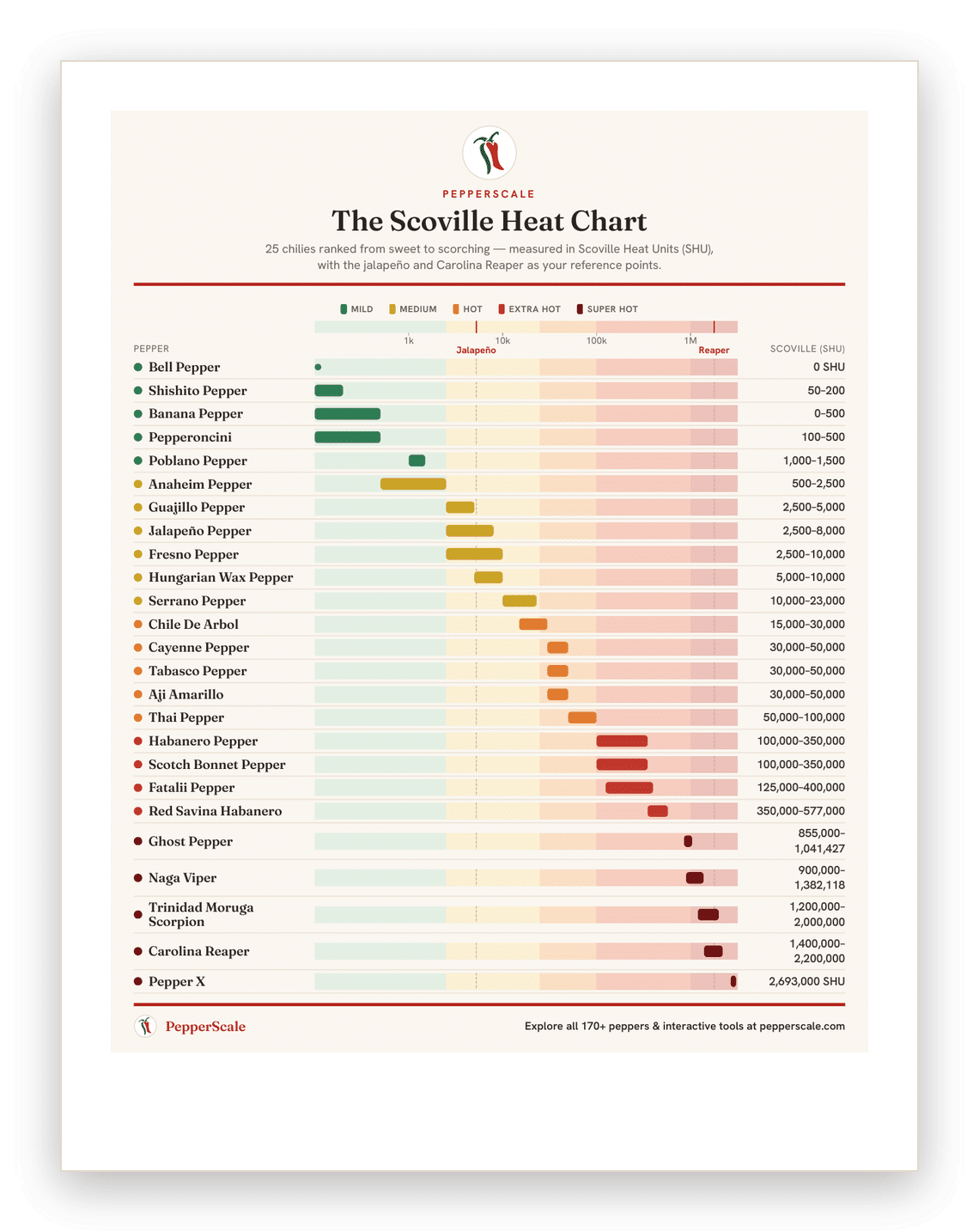
Get the free PepperScale Scoville Heat Chart
A printable, at-a-glance ranking of 25 chilies from sweet to scorching — with the jalapeño and Carolina Reaper as your reference points. Join the newsletter and we’ll send it straight to your inbox.
No spam — just Wicked Wednesday recipes and occasional extra dashes of chili pepper inspiration. Unsubscribe anytime.
Related reading
- The Hot Pepper List: More than 150 chilies you can sort by heat, flavor and how you’d use them.
- How Temperature Changes a Chili Pepper’s Heat: Why the same pepper can taste hotter or milder depending on temperature, and how to use that when you cook.
- Craving Spicy Food? What Makes Us Want It and Why: Capsaicin sets off the burn, and this is the other half of the story: why we keep coming back for more.
The US Military Field survival manual, in at least one editon states, someone who eats spicy peppers in their diet regularly aren’t as susceptible to intestinal parasites as those who don’t. They don’t say anything about the science behind this statement.